Quality
Quality is built into the job: QC cannot sign off a step that needs thickness readings until they are entered, and every reject carries a reason code and a disposition. NCRs, CAPAs, lab tests, training, controlled documents and gauge calibration live under the same menu.
The Quality page
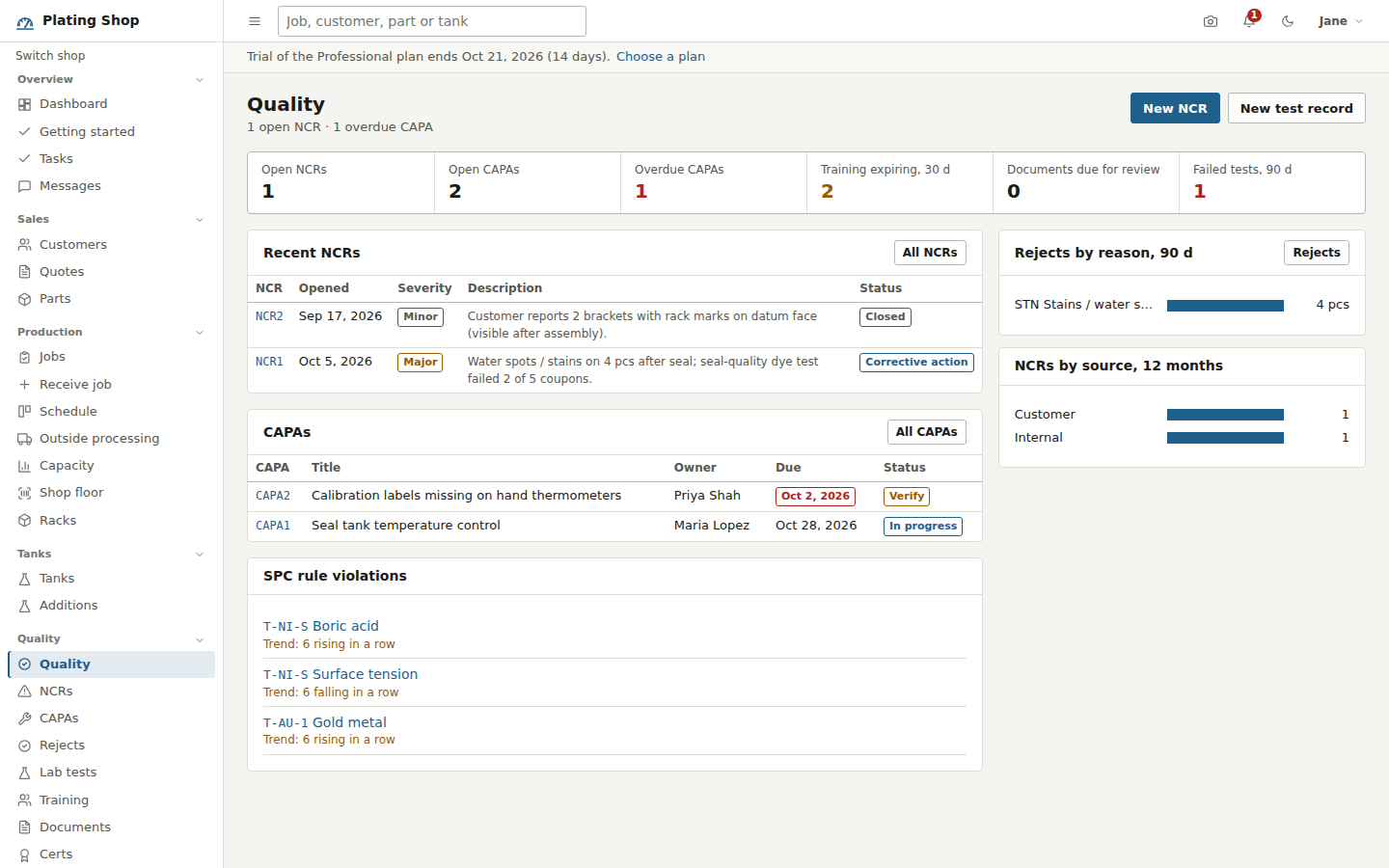
Quality opens on a strip of counts, each a link: open NCRs, open CAPAs, overdue CAPAs, training expiring within 30 days, documents due for review and failed tests in the last 90 days. Below it are the recent NCRs, the CAPAs with owner and due date, the SPC rule violations on tank chemistry, rejects by reason over 90 days and NCRs by source over twelve months.
Thickness readings and QC sign-off
Readings are entered on the job page or from the Readings button on the shop floor terminal: one or more values in the job's unit (mil, in, µin or µm), the location on the part, and the gauge from the equipment list. The job shows n, minimum, maximum and average with a pass or fail against the tolerance, and each reading outside it is marked. When the job has a thickness spec, a QC operation cannot be completed until at least one reading exists; the Complete dialog says so. The readings, the gauges and their calibration dates are snapshotted onto the cert at shipment.
Rejects
Rejects are recorded when an operation is completed, on receipt from an outside processor, or from Record reject on the job: quantity, reason code, the operation they were found at, the source (found in-house or a customer return) and a disposition. Strip and replate creates a linked rework job; the other dispositions are scrap, use as is and return to customer. The Rejects page lists every reject event for a date range and source with totals of pieces rejected, reworked and scrapped, a Pareto of reasons and the reject rate by process. Each row has a button that opens an NCR pre-filled with the job, quantity and reason.
NCRs
A nonconformance report is numbered by the shop's own sequence and opened from NCRs, from a job (Open NCR) or from a reject.
| Field | Values |
|---|---|
| Source | Internal, customer, supplier, audit |
| Severity | Minor, major, critical |
| Customer, job, part, quantity affected | Linked records; the NCR appears on the job page |
| Description, containment, root cause | Text; root cause as 5 whys or fishbone |
| Disposition | Rework, scrap, use as is, return to customer, repair, regrade |
| Cost of quality, owner | The owner is notified when the NCR is assigned to them |
| Status | Open, investigating, corrective action, closed |
Close NCR requires a disposition and takes the root cause. Open CAPA creates a corrective action from the NCR, copying its description and root cause, and moves the NCR to corrective action.
CAPAs
A CAPA is corrective or preventive, with a source (NCR, audit, customer, internal, management review), the related NCR, a title, problem statement, root cause, action plan, owner and due date, 30 days out by default. Status moves through open, in progress, verify and closed. Action items are tasks assigned to people with their own due dates; they show on the CAPA and in each person's Tasks list. Record verification writes how effectiveness was checked, for instance no recurrence in 60 days. Marking it effective closes the CAPA and its NCR together; not effective puts the CAPA back in progress.
Lab tests
Lab tests records salt spray, adhesion, hull cell, thickness audit, hardness, solderability, porosity, seal quality, coating weight and embrittlement tests, each with the date, the specification or method (ASTM B117 96 h, ASTM B571, ASTM F519), duration in hours, a pass, fail or pending result, readings, the equipment used and the job or, for a hull cell, the tank.
Training matrix
Courses are defined under Setup > Training courses with a code, title, renewal period in months and the roles that require them. Training shows the matrix of people against courses: each cell is current with its expiry date, expiring within 30 days, expired, or missing for a required course, and blank where the course is not required for the role. Record training takes the employee, course, completion date, an expiry (from the renewal period if left blank), the trainer and a score.
Controlled documents
Documents holds procedures, work instructions, forms, specifications, policies, the quality manual and drawings, each with a number, a revision starting at A, an owner and a review date. A new document is a draft. Approve records the approver and the effective date and sets the next review a year out; a document is approved by a manager, administrator or QC other than its owner. Revise on an approved document archives the approved text into the revision history, requires a change summary and opens the next revision as a draft. Make obsolete withdraws a document while keeping it for the record.
Equipment and calibration
Equipment & calibration keeps rectifiers, ovens, thickness gauges, thermometers, pH meters and other instruments with a serial number, work center, calibration interval and next due date, and a maintenance interval and next due date. Log entry records a calibration, preventive maintenance, repair or tank analysis with a pass, adjusted or fail result and the readings. A pass sets the next due date from the interval; a fail puts the equipment out of service. Every change in these records is written to the audit trail with who made it and when.